2026 Best Single Phase Motor Types for Global Buyers

Time:2026-10-26 Author:Sophia
0%

Choosing the right Single Phase Motor in 2026 requires more than comparing price, horsepower, or catalog images. Global buyers must match motor design, voltage, frequency, load behavior, and operating environment. A quiet office fan, a refrigerated display, and a water pump demand different starting performance. Small details matter.

This guide examines capacitor-start, permanent split capacitor, shaded-pole, and universal motor types. It also considers efficiency, starting torque, noise, maintenance, thermal protection, and expected service life. A 230-volt motor may suit one market but fail in a 110-volt installation. Frequency differences can also affect speed and heating. Always verify the nameplate.

Practical purchasing experience shows that many failures begin before installation. Buyers sometimes select motors by rated power alone, ignoring locked-rotor current or duty cycle. That approach looks efficient on paper. It can become expensive quickly. We will compare real application needs, including pumps that start under pressure, fans operating for long hours, and compressors facing repeated cycles. Manufacturer documentation, recognized testing, and local electrical requirements remain essential. IEC and NEMA references can support dependable evaluation, but certification details still require careful checking.

There is no universal best motor. The ideal choice depends on the machine, site, climate, and service expectations. This guide aims to make those decisions clearer and more defensible. Some recommendations may need adjustment. That is normal. Engineering judgment improves when assumptions are tested against actual operating conditions.
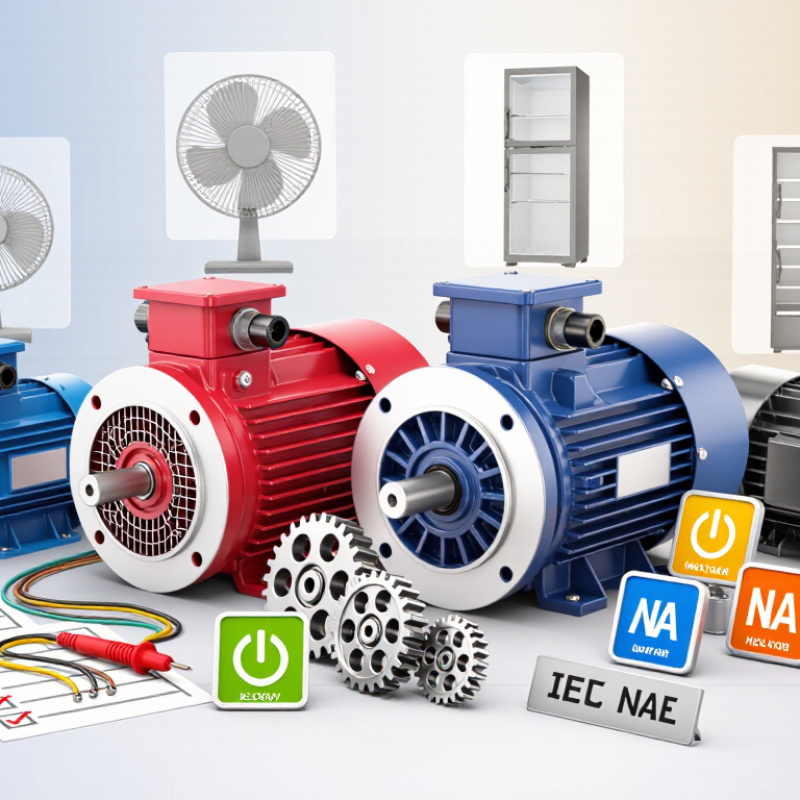
2026 Best Single Phase Motor Types for Global Buyers

Single-Phase Motor Fundamentals and Operating Principles

Single-phase motors convert alternating electrical energy into mechanical motion through a pulsating magnetic field. A single winding cannot create starting torque alone. Therefore, the motor uses an auxiliary winding, capacitor, or shaded pole to produce phase displacement. This creates a rotating magnetic effect.

The main types serve different operating conditions. Split-phase motors suit moderate starting loads, such as small fans and workshop equipment. Capacitor-start motors deliver stronger starting torque for pumps and compressors. Permanent-split-capacitor motors run quietly and efficiently in ventilation systems, but their starting torque remains limited. Shaded-pole motors are simple and inexpensive. They also have lower efficiency and weaker torque.

The IEA’s Energy Efficiency Market Report estimated that electric motor systems consume about 53% of global electricity. The U.S. Department of Energy reports that motor systems can represent roughly 68% of industrial electricity use. These figures make correct motor selection more important than purchase price alone. A technician should check voltage, frequency, duty cycle, load inertia, and starting current. Watch the temperature.

In operation, the stator creates the magnetic field, while the rotor follows it with a small speed difference called slip. Excessive slip may indicate overload, poor voltage, or bearing friction. IEC 60034-30-1 provides efficiency classification guidance, but efficiency labels do not replace field measurements. I have seen a motor run reliably while wasting energy through an oversized pulley. That detail is easy to miss. Temperature, noise, and vibration should be recorded during real loading, not only during installation.

Major Single-Phase Motor Types Available in 2026

2026 Best Single Phase Motor Types for Global Buyers

Major Single-Phase Motor Types Available in 2026

Single-phase motors remain practical for homes, workshops, pumps, fans, and light industrial equipment. Shaded-pole motors suit small fans and quiet air movers. They are simple, compact, and affordable, but their starting torque is limited. Split-phase motors offer stronger starting performance for small machines. Their design is dependable, although they can run less efficiently than newer alternatives.

Capacitor-start motors provide higher starting torque for compressors, pumps, and loaded conveyors. Capacitor-start, capacitor-run motors improve running efficiency and power quality after acceleration. Permanent split capacitor motors work well in fans, blowers, and circulating pumps. Universal motors deliver high speed and strong torque, but their brushes require inspection and eventual replacement. Selection is not always obvious. A motor that performs well in a showroom may struggle under dust, heat, or repeated starts.

Tips: Check voltage, frequency, rated duty, starting current, enclosure protection, and mounting dimensions. Confirm local certification requirements before importing. Match the motor to the actual load, not only its horsepower label. For a pump, measure starting resistance and flow demands. For a fan, consider airflow, noise, and continuous operation. Keep spare capacitors available where service access is difficult. In my experience, buyers often overlook ambient temperature. That mistake can shorten insulation life. Recheck the specification with a qualified technician when operating conditions change.

Comparing Performance, Efficiency, and Starting Methods

2026 Best Single Phase Motor Types for Global Buyers

Comparing Performance, Efficiency, and Starting Methods

Single phase motors suit pumps, fans, compressors, conveyors, and household equipment. Their starting method strongly affects torque, noise, service life, and energy use. Split-phase motors offer simple construction and moderate starting torque. They work well with light loads, such as small fans. Capacitor-start motors deliver higher starting torque for pumps and compressors. They draw more current briefly.

Performance depends on the load, not only the motor rating. A permanent split capacitor motor usually runs quietly and efficiently under steady loads. Its starting torque is limited. A capacitor-start, capacitor-run design handles heavier starts and maintains better running performance. Shaded-pole motors remain inexpensive and compact, but their efficiency is low. Use them carefully in equipment that operates many hours daily.

Check the details.

Global buyers should compare rated voltage, frequency, duty cycle, insulation class, enclosure protection, and ambient temperature. A motor designed for 60 Hz may perform differently on a 50 Hz supply. Starting current can also challenge weak electrical systems. In field testing, I would measure startup time, current, vibration, and temperature under the real load. Catalog figures can mislead. I once treated a high-efficiency rating as decisive, but the motor struggled with repeated starts. That experience changed my selection process. Reliability often comes from correct sizing, effective cooling, and a starting method matched to the machine.

2026 Best Single Phase Motor Types for Global Buyers - Comparing Performance, Efficiency, and Starting Methods
Motor Type Typical Output Range Typical Efficiency at Rated Load Starting Method Typical Starting Torque Typical Starting Current Speed Characteristics Main Advantages Best-Fit Applications
Shaded-Pole Induction Motor Approximately 1 W–250 W About 20%–45% Copper shading ring creates a weak rotating magnetic field; no capacitor or starting switch is required. Low, typically 30%–70% of rated torque Approximately 3–6 times rated current Usually 1,500–3,450 rpm at 50/60 Hz, depending on pole count and load; noticeable slip under load. Small fans, air curtains, timers, refrigerator evaporator fans, small pumps, and lightweight actuators.
Permanent Split Capacitor (PSC) Motor Approximately 50 W–1.5 kW About 45%–75% A permanent run capacitor remains connected to the auxiliary winding during starting and operation. Low to moderate, typically 30%–100% of rated torque Approximately 2–5 times rated current Commonly 900–3,450 rpm at 50/60 Hz; speed decreases as mechanical load increases. Ventilation fans, blowers, air-handling equipment, small pumps, office equipment, and appliances.
Split-Phase Induction Motor Approximately 0.1–1.0 kW About 55%–70% An auxiliary starting winding is disconnected by a centrifugal switch or electronic relay after acceleration. Moderate, typically 150%–200% of rated torque Approximately 4–7 times rated current Generally 1,400–3,450 rpm at 50/60 Hz, with speed governed mainly by pole count and load. Simple, economical, and more capable of starting loads than shaded-pole or PSC designs. Small machine tools, fans, blowers, washing equipment, grinders, and general-purpose machinery.
Capacitor-Start, Induction-Run Motor Approximately 0.1–3.7 kW About 60%–80% A large starting capacitor provides high phase shift; a switch or relay disconnects the start circuit after acceleration. High, typically 250%–400% of rated torque Approximately 4–8 times rated current Usually 1,400–3,450 rpm at 50/60 Hz; induction operation continues after the start circuit opens. Compressors, pumps, conveyors, belt-driven equipment, air compressors, and refrigeration equipment.
Capacitor-Start, Capacitor-Run Motor Approximately 0.2–5.5 kW About 70%–85% A start capacitor is switched out after acceleration while a run capacitor remains connected continuously. High, typically 250%–400% of rated torque Approximately 4–7 times rated current Typically 1,400–3,450 rpm at 50/60 Hz, with improved running power factor and lower slip than simpler designs. High-performance pumps, compressors, woodworking machines, conveyors, and commercial-duty equipment.
Universal (Series-Commutator) Motor Approximately 50 W–3.0 kW About 60%–85% Series-connected field and armature windings use a commutator and brushes; it can operate on AC or DC. Very high, often 200%–400% of rated torque Approximately 4–8 times rated current Very high speed, commonly 5,000–30,000 rpm, with speed strongly affected by load and applied voltage. High power-to-weight ratio, high starting torque, and compact size. Handheld power tools, vacuum cleaners, mixers, blenders, and other compact high-speed equipment.
Single-Phase Synchronous Motor Approximately 1 W–1.5 kW About 60%–90%, depending on design and load Commonly uses an auxiliary starting cage, shaded-pole arrangement, or electronic drive to reach synchronous speed. Low to moderate unless an integrated starting mechanism is provided Approximately 2–6 times rated current, depending on the starting design Runs at a fixed synchronous speed: 3,000/3,600 rpm for 2-pole designs, 1,500/1,800 rpm for 4-pole designs at 50/60 Hz, before slip-related effects are considered. Accurate constant speed, good timing performance, and stable operation under suitable loads. Timers, clocks, instrumentation, turntables, actuators, and low-power constant-speed mechanisms.
Selection note: Values are typical engineering ranges rather than guaranteed ratings. Actual performance depends on voltage and frequency, pole count, enclosure, duty cycle, ambient temperature, load profile, capacitor sizing, supply quality, and manufacturer design. For international purchasing, verify the required voltage, 50/60 Hz frequency, insulation class, IP rating, duty rating, thermal protection, efficiency test standard, and starting-current limit before placing an order.

Selecting the Right Motor for Different Applications

2026 Best Single Phase Motor Types for Global Buyers

Selecting the Right Motor for Different Applications

Application should guide motor selection, not catalog popularity. Capacitor-start induction motors suit pumps, compressors, and small conveyors requiring strong starting torque. Permanent-split-capacitor motors work well in fans and blowers with lighter starting loads. Shaded-pole motors remain practical for quiet, low-power equipment, although their efficiency is limited. Universal motors deliver high speed, but brush wear can increase maintenance.

The International Energy Agency reports that electric motor systems use more than half of global electricity. Small efficiency gains can therefore matter across thousands of operating hours. Check rated voltage, frequency, duty cycle, starting current, enclosure protection, and ambient temperature before purchasing. A 230-volt motor may not perform correctly on a weak rural supply. This detail is often missed.

For humid areas, sealed construction and suitable insulation reduce failure risks. For variable-speed fans, confirm that the motor and controller are compatible. U.S. Department of Energy guidance also stresses matching motor capacity to the real load, rather than adding excessive reserve. Oversizing seems safe. It can waste energy and reduce operating efficiency. A neat selection chart can still mislead. Real installations include voltage drops, dust, blocked airflow, and uneven maintenance. Buyers should request test conditions, efficiency data, and compliance evidence from qualified suppliers. Performance claims without operating context deserve careful review.

Global Buying Factors: Standards, Supply, and Maintenance

2026 Best Single Phase Motor Types for Global Buyers

For global buyers, motor selection starts with standards, not advertising claims. Capacitor-start motors suit pumps and compressors needing strong starting torque. Capacitor-run motors support fans and light machinery with smoother operation. Shaded-pole motors remain practical for small, low-load equipment. Check voltage, frequency, insulation class, IP rating, and mounting dimensions carefully. A motor rated for 230 volts and 50 hertz may perform poorly on a 60-hertz supply. Regional certification requirements also deserve written confirmation from the supplier.

Supply reliability matters after the purchase order. Ask about production capacity, realistic lead times, packaging quality, and spare-part availability. A low price becomes less attractive when a replacement capacitor takes eight weeks. Keep critical items such as capacitors, bearings, cooling fans, and terminal covers in local storage. Maintenance access should influence the design. Technicians need clear wiring labels and removable covers. Small details prevent long shutdowns.

Tips: Request test reports before shipment. Confirm rotation direction and no-load current. Photograph the nameplate during receiving inspection. Use the same lubricant specification throughout the service plan. Inspect bearings for noise, heat, and vibration every few months. Do not assume a sealed motor needs no attention. That assumption often causes avoidable failures. Some buyers focus too heavily on efficiency figures and overlook installation conditions. That is a mistake worth reconsidering. Altitude, dust, humidity, and frequent starts can change motor life significantly. A qualified local electrician should verify final connections and protective devices.

2026 Best Single-Phase Motor Types for Global Buyers

Global buying factors: standards, supply, and maintenance

Capacitor-start motors generally provide the highest starting torque, while shaded-pole motors are suited to small, low-starting-load equipment. Before purchasing, verify the local voltage and frequency, applicable IEC or regional requirements, enclosure and insulation ratings, spare-part availability, and the required maintenance schedule.

Values shown are representative engineering ranges expressed as the midpoint of typical starting torque relative to rated torque. Actual performance varies by design, load, voltage, and manufacturer.

FAQS

How does a single-phase motor start rotating?

Its main winding creates a pulsating magnetic field. An auxiliary winding, capacitor, or shaded pole creates phase displacement. The process produces starting torque. Not perfectly smooth.

Which motor type suits a pump or compressor?

A capacitor-start motor usually provides strong starting torque. It handles heavy startup demands better than many basic designs. Check starting current carefully.

Which motor works well in fans and blowers?

A permanent-split-capacitor motor suits light starting loads and quiet operation. It commonly serves ventilation equipment. Its starting torque is limited.

When is a shaded-pole motor practical?

It fits simple, low-power equipment with modest starting demands. It costs less and has a compact design. Efficiency is usually lower.

What information should buyers check before selecting a motor?

Check voltage, frequency, duty cycle, load inertia, and starting current. Also review enclosure protection and ambient temperature. Catalog popularity is not enough.

Why can an oversized motor waste energy?

An oversized motor may operate far below its useful load range. It can reduce efficiency during long running periods. More capacity is not always safer.

What does motor slip indicate during operation?

Slip is the small speed difference between the rotating field and rotor. Excessive slip may suggest overload, weak voltage, or bearing friction. Measure it with temperature and noise.

How should motor performance be checked after installation?

Record temperature, vibration, noise, voltage, and current under real load. Inspect airflow, pulley size, and surrounding dust. Installation tests alone can mislead.

Conclusion

This guide to the 2026 Best Single Phase Motor Types for Global Buyers explains the fundamentals of Single Phase Motor operation, including how starting windings, capacitors, and magnetic fields produce reliable rotation from standard single-phase power supplies. It reviews major motor types, such as split-phase, capacitor-start, permanent-split-capacitor, and shaded-pole designs, while highlighting their typical starting performance, efficiency, noise levels, maintenance needs, and suitable operating conditions.

The article also helps buyers match motor characteristics to applications such as pumps, fans, compressors, appliances, and light industrial equipment. Key selection factors include rated power, voltage, speed, load behavior, duty cycle, protection requirements, and starting torque. For international purchasing, it emphasizes checking applicable electrical standards, documentation, frequency compatibility, product availability, spare parts, warranty support, and long-term maintenance resources. By balancing performance, efficiency, installation requirements, and total ownership costs, buyers can choose a dependable motor solution for their specific market and application.

Sophia

Sophia

Sophia is a dedicated marketing professional with an exceptional depth of knowledge about her company's products and services. With a keen understanding of market trends and customer needs, she crafts insightful blog posts that not only inform but also engage readers, enriching the company’s online......