Choosing the right Robotic Motor in 2026 requires more than comparing torque ratings and purchase prices. A motor may look powerful on a datasheet yet struggle when a robotic joint accelerates repeatedly, carries an uneven load, or operates near a heat source. Real performance depends on torque, speed, duty cycle, efficiency, noise, backlash, thermal limits, and feedback accuracy. Small details matter. A 2-kilogram gripper can demand surprising torque when its arm extends 60 centimeters.
Reliable selection begins with the robot’s actual working conditions. Engineers should measure peak and continuous loads, calculate acceleration requirements, and examine the motor’s operating curve. Servo motors suit applications needing precise positioning and rapid correction, while stepper motors can offer simpler control and lower initial cost. Harmonic-drive, planetary, and direct-drive systems each create different trade-offs in weight, precision, maintenance, and price. Integration also matters. Check controller compatibility, encoder resolution, voltage, mounting dimensions, cable routing, and available technical support before ordering.
Experience suggests that laboratory tests often hide problems. A motor can perform well for ten minutes and overheat after eight hours. That is an uncomfortable gap. Independent testing, supplier documentation, certification records, and field references provide stronger evidence than marketing claims alone. No single Robotic Motor fits every machine. The best choice may still require prototype testing, revised calculations, and a second review from a controls or mechanical specialist. In 2026, thoughtful evaluation should balance present performance with future serviceability, energy use, cybersecurity considerations, and changing production demands. Mistakes remain possible, but disciplined verification makes them less expensive.
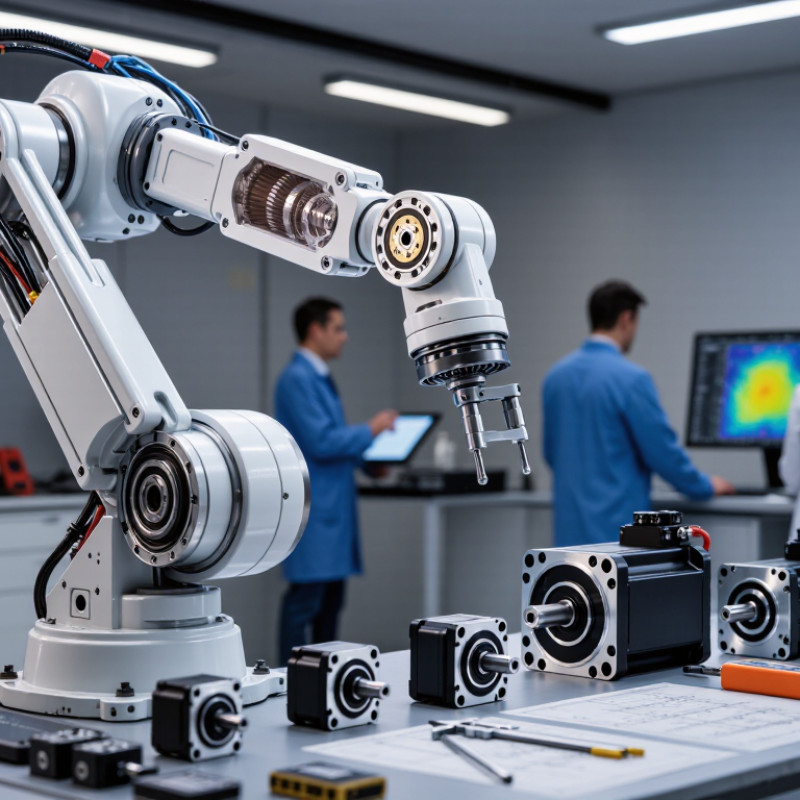
A robotic motor converts electrical energy into controlled movement. It drives joints, wheels, grippers, and linear mechanisms. Unlike a simple rotating motor, it often works with sensors, gearboxes, and feedback software. The controller measures position and adjusts power within milliseconds. That closed loop helps a robot move accurately beside people or handle fragile objects.
In 2026, motor selection matters because robots are becoming smaller, smarter, and more energy-conscious. A warehouse arm may repeat the same lift thousands of times daily. Its motor needs sufficient torque, stable speed, low heat, and reliable braking. A mobile robot faces different demands. It needs efficient movement, quiet operation, and long battery life. I usually check continuous torque before peak torque. Peak figures can look impressive, but they may last only briefly.
Do not ignore the operating environment. Dust, moisture, vibration, and frequent stops can shorten service life. Encoder resolution also affects precision, especially when a gripper must place a component within a fraction of a millimeter. In testing, I record temperature after extended cycles, not just during a short demonstration. That detail is easy to miss. I have also seen designs prioritize maximum speed and later struggle with noise, backlash, or unstable control. A slightly slower motor may deliver better accuracy and lower maintenance over time. The correct choice depends on the complete motion system, not the motor alone.
Motor selection starts with motion, not catalog size. Define the joint’s speed, acceleration, travel range, and duty cycle. A wrist joint may need rapid reversals, while a conveyor axis needs steady rotation. Record real motion profiles, including pauses and emergency stops. Guessing here creates expensive errors later.
Measure the load at the motor shaft. Calculate torque from force multiplied by lever radius. Add payload, tooling, cable drag, and friction. Then include reflected inertia and a practical safety margin.
The International Federation of Robotics reported 541,302 industrial robot installations in 2023, with more than 4.28 million robots operating worldwide in 2023. That scale makes repeatable sizing more important, not less. A motor that survives one test may fail after thousands of cycles. I have seen “temporary” friction become the main design problem.
Control requirements deserve equal attention. Choose feedback resolution based on positioning accuracy, not marketing claims. Specify encoder type, communication speed, braking behavior, and fault response. Industrial robot systems often require coordinated motion across several axes. Small timing errors can produce visible vibration.
The IFR’s World Robotics 2024 data also shows continued growth in automation adoption, increasing pressure for dependable integration. Keep the control loop understandable. Complex is not always better. Test the motor under heat, peak torque, and repeated reversals.
My own weak assumption would be treating rated torque as continuous torque; that mistake needs challenging before procurement.
Choosing the right robotic motor starts with the application, not the catalogue. Each motor type handles motion differently. A brushed DC motor suits simple wheels, pumps, and small conveyor mechanisms. It offers low cost and straightforward control, but its brushes wear over time.
A brushless DC motor fits mobile robots and continuous-duty joints. It runs quietly and usually handles longer operating cycles. However, it needs electronic commutation and careful speed control. For precise arms, pan-tilt units, and camera platforms, servo motors provide feedback through encoders. They correct position errors while the robot moves. Keep feedback reliable. A stepper motor works well in indexing tables and low-speed linear stages. Its open-loop control simplifies wiring. Yet missed steps can occur when loads change suddenly.
For compact grippers and lightweight inspection tools, coreless motors can reduce moving mass. They respond quickly, although their short-term peak performance may hide heating problems. Geared motors help when torque matters more than speed. Check backlash before using them in precision joints. I once selected a motor by rated torque alone, and the gearbox overheated during repeated reversals. That choice was not perfect.
Measure the real load, acceleration, duty cycle, and available voltage. Test the motor with the intended gearbox, controller, and payload. Watch temperature after several operating cycles. A motor that feels powerful on a workbench may struggle inside a warm, enclosed joint. Noise, maintenance access, encoder resolution, and braking behavior also influence the final choice.
| Motor Type | Typical Continuous Torque Range | Typical Speed Range | Positioning Capability | Best-Fit Robotic Applications | Main Advantages | Key Limitations | Recommended Control Method | Energy and Maintenance Profile |
|---|---|---|---|---|---|---|---|---|
| Brushed DC Motor | 0.01–10 N·m | 1,000–10,000 rpm | Moderate | Low-cost mobile robots, small conveyor mechanisms, educational robots, simple grippers and auxiliary actuators | Simple drive electronics, strong starting torque, broad availability and relatively low initial cost | Brush and commutator wear, electrical noise, limited service life in demanding duty cycles and lower efficiency than brushless designs | H-bridge with PWM; add an encoder when closed-loop speed or position control is required | Moderate efficiency; periodic brush replacement may be required depending on load, speed and duty cycle |
| Brushless DC Motor (BLDC) | 0.02–100 N·m | 1,000–20,000 rpm | High with encoder | Mobile robot wheels, drones, robotic joints, inspection systems, cooling systems and high-duty automation axes | High power-to-weight ratio, efficient operation, low mechanical wear and good suitability for continuous motion | Requires electronic commutation; sensorless control can be less reliable at very low speed or during startup | Six-step or sinusoidal commutation; field-oriented control is preferred for smooth, quiet and efficient motion | High efficiency and low mechanical maintenance; bearings and electronics remain the main service items |
| Permanent-Magnet AC Servo Motor | 0.5–500+ N·m | 500–6,000 rpm | Very high | Industrial robot joints, precision linear axes, articulated arms, high-speed pick-and-place systems and synchronized motion platforms | Excellent dynamic response, high overload capability, precise torque control and stable performance over a wide speed range | Higher system cost, more complex tuning and the need for a compatible servo drive and feedback device | Closed-loop current, velocity and position control with an encoder or resolver | High efficiency when correctly sized; low routine maintenance but requires professional commissioning and tuning |
| Stepper Motor | 0.05–20 N·m | 0–1,500 rpm | High at low speed | 3D printers, desktop CNC equipment, indexing mechanisms, low-cost Cartesian robots and light-duty positioning stages | High holding torque, simple open-loop operation, repeatable incremental motion and low controller complexity | Torque drops rapidly as speed increases; may lose steps under overload and can generate vibration or audible resonance | Microstepping driver; use a closed-loop stepper system when missed-step detection is important | Moderate to low efficiency when holding position because current may remain applied at standstill; minimal mechanical maintenance |
| Direct-Drive Torque Motor | 5–1,000+ N·m | 1–500 rpm | Very high | Precision rotary tables, collaborative robot joints, gimbal systems, semiconductor equipment and low-speed high-torque axes | Eliminates gearbox backlash, provides smooth motion, high stiffness and strong torque density at low speed | Large diameter, higher motor and drive cost, heat dissipation challenges and limited maximum speed | Closed-loop vector control with high-resolution encoder feedback and accurate thermal monitoring | Efficient for low-speed direct motion; reduced mechanical wear because no gearbox is used |
| Harmonic-Drive Gearmotor | 5–800 N·m at output | 5–300 rpm at output | Very high | Compact robotic arms, wrist joints, humanoid robots, camera positioning systems and applications requiring low backlash | High reduction ratio in a compact package, low backlash, high positioning accuracy and coaxial construction | Lower torsional stiffness than some rigid gear trains, finite flex-spline fatigue life and reduced efficiency at high reduction ratios | Servo control with encoder feedback on the motor and, preferably, output-side position feedback | Good energy efficiency for intermittent precision motion; requires correct lubrication and protection from shock overloads |
| Planetary Gearmotor | 1–2,000 N·m at output | 10–1,500 rpm at output | High | AGV and AMR drive wheels, robot joints, lifting mechanisms, palletizing systems and high-load rotary axes | High torque density, good radial load capacity, multiple reduction ratios and generally strong mechanical durability | Backlash and friction vary by design; gearbox noise, wear and efficiency losses increase with reduction ratio and load | Servo or BLDC control with encoder feedback; select low-backlash gearing for precision positioning | Good overall efficiency for moderate ratios; requires lubrication and periodic inspection in high-load applications |
| Cycloidal Gearmotor | 50–5,000+ N·m at output | 5–200 rpm at output | High | Heavy-duty robot joints, welding robots, large manipulators, lifting axes and shock-loaded industrial equipment | High shock-load resistance, large torque capacity, long service life and low backlash when properly preloaded | Typically heavier and larger than compact harmonic gearboxes; may produce more vibration and requires accurate alignment | Closed-loop servo control with motor and output feedback for high-accuracy motion | Suitable for demanding duty cycles; lubrication quality and bearing condition are critical to service life |
| Ultrasonic Piezoelectric Motor | 0.001–1 N·m | 10–1,000 rpm | Very high at small scale | Micro-robotics, optical positioning, medical instruments, miniature lenses and compact precision mechanisms | Compact size, high holding force without conventional gears, low electromagnetic interference and fine positioning capability | Limited torque and travel speed, sensitivity to preload and contact-surface wear, and specialized drive requirements | High-frequency AC drive with position feedback when closed-loop accuracy is required | Efficient for intermittent micro-positioning; contact surfaces and preload components require careful management |
| Electrohydraulic Actuator | 100–50,000+ N·m equivalent | Application-dependent; typically low to moderate | High with feedback | Heavy mobile robots, legged robots, construction robotics, high-force manipulators and outdoor systems | Very high force and power density, strong shock tolerance and suitability for heavy loads | Pump and valve complexity, fluid leakage risk, noise, heat generation and higher maintenance requirements | Proportional valve or servo-valve control with pressure, position and velocity feedback | Can deliver high force efficiently at large scale; requires fluid filtration, seal inspection and thermal management |
Note: Torque and speed values are typical engineering ranges rather than guaranteed ratings. Final motor selection should be based on reflected load inertia, peak and continuous torque, duty cycle, acceleration, thermal limits, gearbox efficiency, environmental conditions, safety requirements and available feedback resolution.
Choosing a robotic motor starts with the real load, not the catalog’s peak rating. Start with the load. Calculate required torque during acceleration, lifting, stopping, and sudden direction changes. Add a safety margin of 30% to 50%, especially for vertical joints. A motor that barely moves a test arm may overheat during repeated cycles. I have seen teams select impressive peak torque, then discover weak continuous performance. That mistake is common.
Speed must match the mechanism, gearing, and working rhythm. High speed means little if the arm overshoots its target. Compare speed under load, not at zero resistance. Precision depends on encoder resolution, gearbox backlash, control quality, and mechanical stiffness. Test a small movement, such as one millimeter, after the motor reaches operating temperature. Measure it warm. Cold measurements can look better than daily performance.
Efficiency affects battery life, heat, and maintenance intervals. Check current draw at typical torque, not only during idle operation. A motor running near its limit wastes energy as heat. Durability requires reviewing bearing loads, duty cycles, vibration, dust exposure, and braking frequency. Request life-test data and protection ratings when available. I would also repeat the test after several thousand cycles, although this step is often skipped. Cost matters, but replacing a misjudged motor can disrupt the entire machine. A quieter motor may still hide inefficient control or excessive gearbox friction.
Define speed, acceleration, travel range, load, and duty cycle. Record pauses and emergency stops. Guessing creates costly errors.
Multiply force by the lever radius. Include payload, tooling, cable drag, friction, and reflected inertia. Add a practical safety margin.
A motor may pass one bench test and fail after thousands of cycles. Test heat, peak torque, repeated reversals, and the actual payload. Warm results matter.
A brushless motor often suits mobile robots and continuously moving joints. It runs quietly and supports long operating periods. Electronic commutation is required.
Servo motors suit precise arms, pan-tilt systems, and camera platforms. Encoders provide position feedback during movement. Feedback must remain reliable.
Steppers suit indexing tables and low-speed linear stages. Their control is simple. Sudden load changes can cause missed steps.
Geared motors increase torque but may reduce speed. Check backlash, gearbox heating, and friction during repeated reversals. Rated torque alone is not enough.
Compare speed under load, not at zero resistance. Precision depends on encoder resolution, backlash, control quality, and mechanical stiffness. Test a one-millimeter movement when warm.
Efficiency affects battery life, heat, and maintenance intervals. Measure current at typical torque. Idle current can look reassuring but hide real energy use.
Treating rated torque as continuous torque is a weak assumption. Peak performance may hide overheating. I would challenge that choice before procurement.
Choosing the right Robotic Motor in 2026 begins with understanding how it converts electrical energy into controlled mechanical movement. The best choice depends on your robot’s required motion, payload, operating speed, workspace, duty cycle, and control architecture. Different applications may call for servo, stepper, brushless, or geared motor solutions, each offering distinct advantages in precision, responsiveness, torque, efficiency, and complexity.
A reliable selection process should compare continuous and peak torque, speed range, positioning accuracy, energy consumption, heat generation, noise, expected service life, and resistance to demanding environments. Compatibility with sensors, controllers, feedback systems, and power supplies is equally important. Before finalizing a Robotic Motor, test it under realistic loads and motion patterns to verify performance and safety margins. Proper installation, lubrication where appropriate, thermal management, inspection, and preventive maintenance will help preserve accuracy and extend operating life. A balanced evaluation ensures the motor supports both current tasks and future upgrades.
